ISO 9001 for Manufacturing: Complete Certification Guide
Published April 7, 2026
ISO 9001 manufacturing is not a new concept, but its importance has never been greater. As supply chains grow more complex, customer expectations rise, and international competition intensifies, manufacturing companies of all sizes are using ISO 9001 to strengthen process control, improve consistency, reduce waste, and demonstrate that their operations can reliably meet customer requirements.
Manufacturing is where ISO 9001 has its deepest roots. But certification alone doesn't improve a factory. The value comes from how the QMS is designed and integrated into daily operations. A well-designed system should help people prevent problems, manage variation, improve processes, and make better decisions – without creating unnecessary paperwork or procedures that nobody follows.
At 9001Simplified, we help manufacturing companies build practical QMSs through DIY toolkits, Hybrid implementation, Full-Service Consultancy, and online training – with the goal of achieving certification while creating a system that delivers real operational value.
What Does ISO 9001 Mean in Manufacturing?
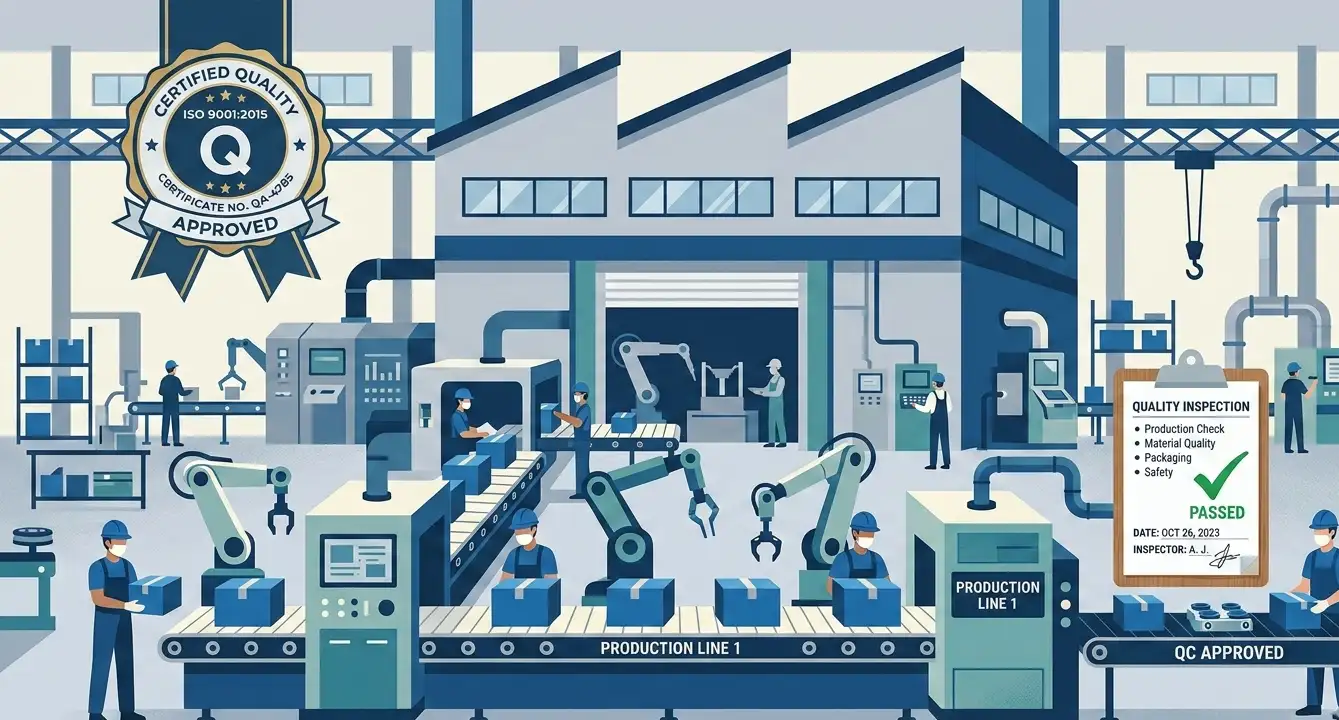
ISO 9001 is the international standard for quality management systems (QMS). It sets the requirements that an organization must meet to demonstrate it can consistently deliver products and services that satisfy customer and regulatory requirements.
For manufacturers, this means having documented, repeatable processes for everything from incoming material inspection to final product release. The standard does not tell you what to manufacture or how to manufacture it. Instead, it provides a management framework that ensures your processes are controlled, monitored, and continuously improved.
The current version is ISO 9001:2015, which introduced a stronger emphasis on risk-based thinking, leadership involvement, and process performance. For a detailed overview of the standard, see our guide on What Is ISO 9001.
Why Manufacturing Companies Need ISO 9001
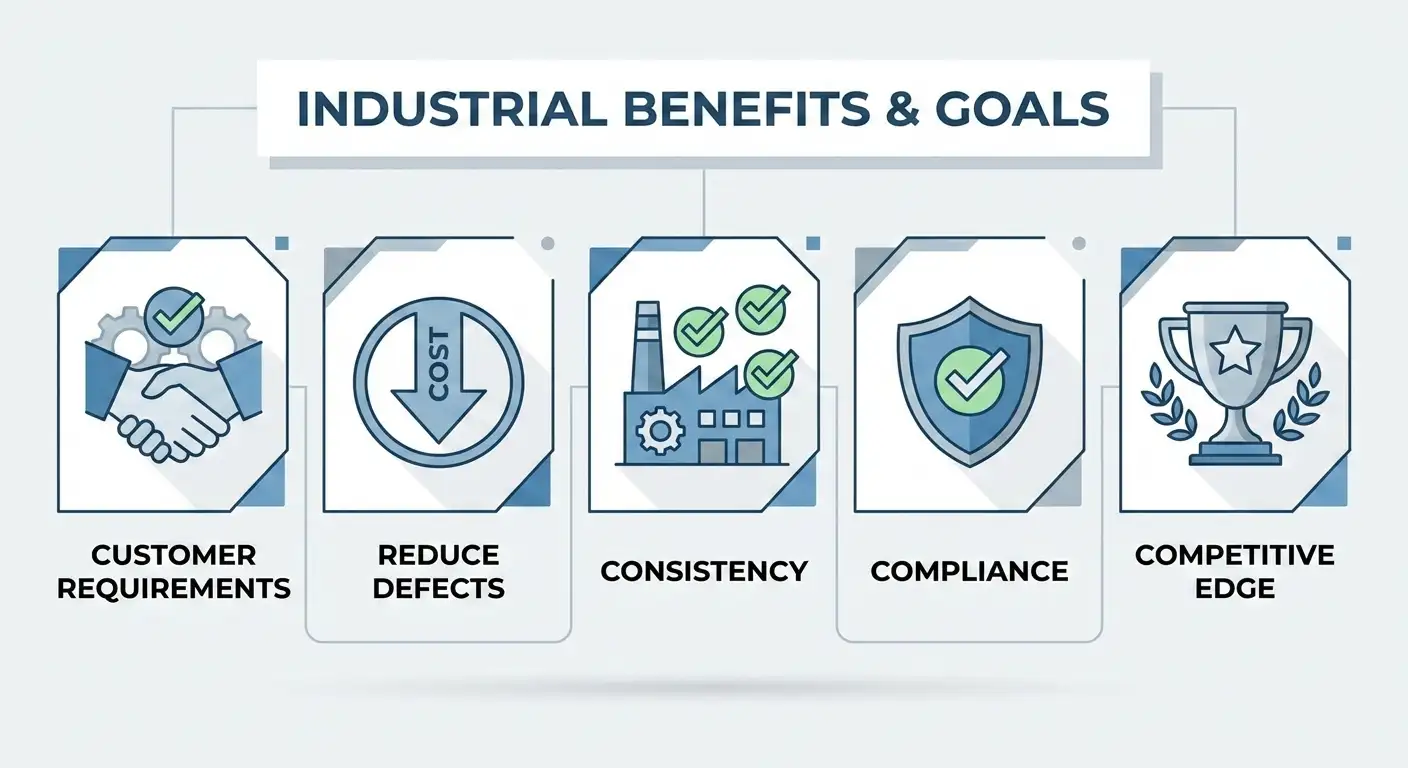
While many manufacturers operate successfully without formal certification, the business environment increasingly rewards companies that have a certified QMS in place. Here are the most compelling reasons to get certified.
Customer and Supply Chain Requirements
Large OEMs, defense contractors, government agencies, and international buyers routinely require their suppliers to hold ISO 9001 certification. Without it, your company may not even be considered for quoting or bidding. In many supply chains, certification is a non-negotiable entry requirement rather than a competitive advantage.
Reducing Scrap, Rework, and Warranty Claims
Manufacturing quality problems are expensive. Scrap materials, rework labor, warranty returns, and customer complaints all eat directly into profit margins. ISO 9001 reduces these costs by requiring documented processes, in-process controls, inspection criteria, and root cause analysis when problems occur. Companies that implement the standard properly typically see measurable reductions in defect rates within the first year.
Operational Consistency Across Shifts and Locations
One of the biggest challenges in manufacturing is maintaining consistent quality across different shifts, operators, and production lines. ISO 9001 addresses this by requiring standardized work instructions, competency-based training, and process monitoring. When every operator follows the same documented process, output variability decreases.
Regulatory Compliance
Many manufactured products are subject to regulatory requirements covering safety, environmental impact, or product performance. While ISO 9001 is not a product standard, its systematic approach to process control, document management, and traceability helps manufacturers maintain compliance with applicable regulations more effectively.
Competitive Differentiation
In crowded markets where multiple suppliers offer similar products, ISO 9001 certification differentiates your company as one that has invested in quality systems. This is especially important for small and midsize manufacturers competing against larger firms for contracts. For more on this topic, see our article on the Game-Changing Benefits of ISO 9001.
How ISO 9001 Applies to Manufacturing Operations
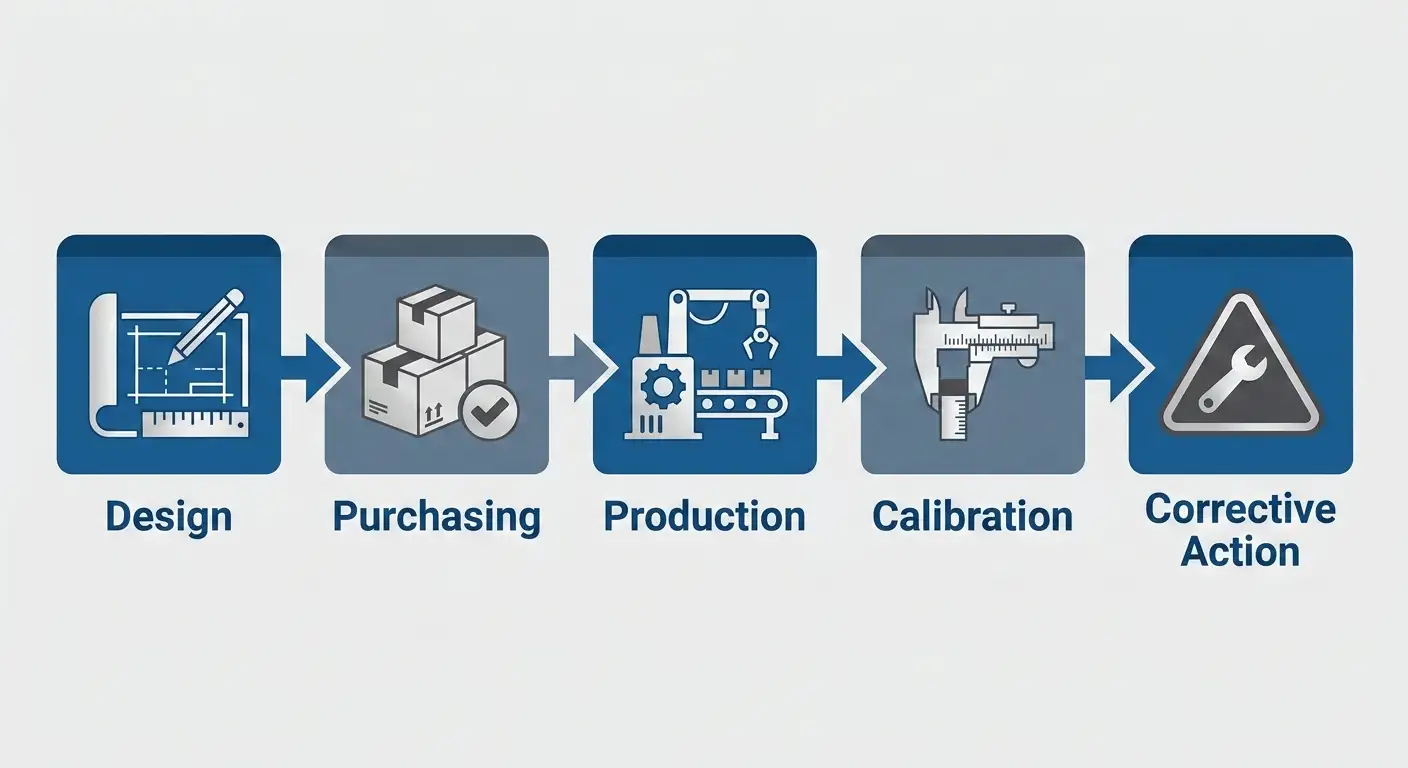
ISO 9001 is structured around a process-based approach, which maps naturally to how manufacturing companies operate. Below is how the key clauses apply to typical manufacturing activities.
Design and Development (Clause 8.3)
If your company designs products, ISO 9001 requires a structured design and development process that includes planning, inputs, controls, outputs, and design changes. This ensures that new products are properly validated before they reach production, reducing the risk of design-related quality failures downstream.
Manufacturers that do not perform design work can exclude this clause from their scope, which is a common and accepted practice.
Purchasing and Supplier Control (Clause 8.4)
Raw materials and components directly affect the quality of finished products. ISO 9001 requires manufacturers to evaluate and select suppliers based on defined criteria, verify incoming materials against specifications, and monitor supplier performance over time.
This is one of the most impactful areas of the standard for manufacturers because poor incoming material quality is a leading root cause of production defects.
Production and Process Control (Clause 8.5)
This is the core of the standard for manufacturing. Clause 8.5 requires controlled conditions for production, including documented work instructions, defined process parameters, appropriate equipment, monitoring and measurement activities, and competent personnel.
For processes where the output cannot be verified by inspection alone (such as welding, heat treatment, or painting), the standard requires process validation to ensure the process consistently produces acceptable results.
Monitoring, Measurement, and Equipment Calibration (Clause 7.1.5)
Manufacturing depends heavily on measurement. ISO 9001 requires that measurement equipment is calibrated or verified at defined intervals against traceable standards. This applies to everything from calipers and gauges to CMMs and testing equipment.
Without a calibration program, you cannot trust your inspection results, and your certification auditor will flag this as a nonconformity.
Product Identification and Traceability (Clause 8.5.2)
ISO 9001 requires product identification throughout production. For many manufacturers, especially those in aerospace, automotive, medical devices, or food processing, full lot traceability is essential. The standard requires that you can trace materials and products through every stage of production when traceability is a requirement.
Nonconformity and Corrective Action (Clause 10.2)
When defects or process failures occur, ISO 9001 requires a formal process for handling nonconforming product (segregate, rework, scrap, or accept with concession) and for investigating root causes to prevent recurrence. This is where many manufacturers see the biggest operational improvement because it transforms reactive firefighting into systematic problem-solving.
ISO 9001 vs Industry-Specific Manufacturing Standards
Manufacturing companies sometimes wonder whether ISO 9001 is sufficient or whether they need a more specialized standard. The answer depends on your industry and customer base.
ISO 9001 vs IATF 16949 (Automotive)
IATF 16949 is required for companies in the automotive supply chain. It includes all ISO 9001 requirements plus additional automotive-specific requirements for production part approval, advanced product quality planning, and failure mode analysis. If your customers are automotive OEMs, you likely need IATF 16949. For general manufacturing, ISO 9001 is sufficient. See our detailed comparison in IATF 16949 vs ISO 9001.
ISO 9001 vs AS9100 (Aerospace)
AS9100 adds aerospace-specific requirements on top of ISO 9001, including product safety, counterfeit part prevention, and configuration management. It is required for aerospace and some defense supply chains. For a full comparison, see AS9100 vs ISO 9001.
ISO 9001 vs ISO 13485 (Medical Devices)
ISO 13485 is the quality management standard for medical device manufacturers. While it shares structure with ISO 9001, it has specific requirements for regulatory compliance, design controls, and risk management unique to medical devices. See ISO 9001 vs ISO 13485.
If you are a general manufacturer not operating in automotive, aerospace, or medical device supply chains, ISO 9001 is the right standard. Many companies start with ISO 9001 and later upgrade to an industry-specific standard if their customer base requires it.
How to Get ISO 9001 Certified as a Manufacturer
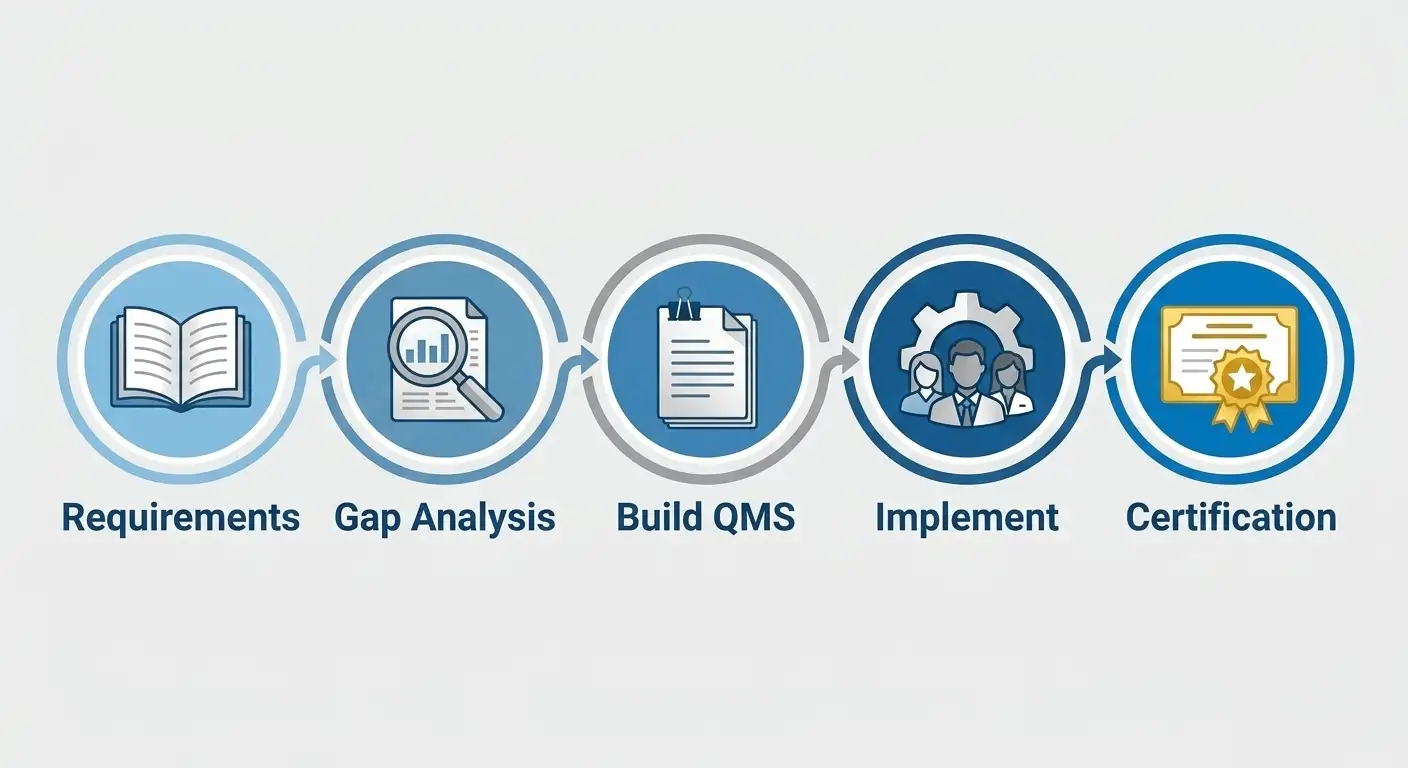
The certification process for manufacturing companies follows these steps:
Step 1: Understand the Requirements
Learn what ISO 9001:2015 requires. The ISO 9001:2015 Requirements page provides a complete clause-by-clause overview.
Step 2: Conduct a Gap Analysis
Assess your current quality practices against the standard. Most manufacturers already have inspection processes, work instructions, and supplier controls in place – a gap analysis identifies what needs to be formalized, documented, or improved.
Step 3: Build Your QMS Documentation
Create or update your quality manual, procedures, work instructions, inspection plans, and forms. Using a documentation toolkit significantly reduces the time and cost of this step. The ISO 9001 Certification Toolkit includes all QMS documents with step-by-step customization guidance.
Step 4: Implement and Train
Put the system into practice on the shop floor and across support functions. Train employees on the QMS and their specific responsibilities. Our ISO 9001 Online Training covers every role from shop floor operators to management.
Step 5: Internal Audit
Conduct a thorough internal audit to verify your system meets ISO 9001 requirements before the external audit.
Step 6: Certification Audit
An accredited registrar audits your QMS in two stages and, if successful, issues your ISO 9001 certificate.
Most manufacturing companies complete this process in 3 to 6 months. Companies with more complex operations or multiple facilities may take longer.
What a Manufacturing QMS Typically Includes
A typical quality management system for a manufacturing company built on ISO 9001 includes:
Quality policy and measurable quality objectives
Organizational chart with defined quality responsibilities
Contract review and order entry procedures
Supplier evaluation and approved supplier list
Incoming material inspection procedures
Production work instructions and process parameters
In-process and final inspection plans with acceptance criteria
Equipment calibration program and records
Nonconforming product control procedures
Corrective action and root cause analysis process
Document and record control system
Employee training and competency records
Customer feedback and complaint handling process
Management review meeting process
The goal is to document how your company actually operates, not to create a parallel paper system. The best QMS documentation reflects your real processes and becomes a tool your team actually uses.
Common Mistakes Manufacturers Make During Implementation
Understanding what goes wrong helps you avoid the same pitfalls. These are the most common mistakes we see manufacturing companies make when implementing ISO 9001:
Creating documentation that nobody uses
The QMS should document your actual processes, not theoretical ideal processes. If your work instructions do not reflect what happens on the shop floor, they are useless and will create audit findings.
Treating it as a quality department project
ISO 9001 is a management system that covers the entire organization. Implementation must involve production, engineering, purchasing, sales, and management — not just the quality team.
Ignoring the calibration program
This is one of the most common nonconformities in manufacturing audits. Every piece of measurement equipment that affects product acceptance decisions must be included in a calibration program.
Skipping management involvement
The standard requires active top management commitment, not just signing the quality policy. If leadership is not visibly engaged, the system will not sustain itself after certification.
For more on what to avoid, see our article on 5 Costly ISO 9001 Mistakes That Ruin Certification.
How 9001Simplified Helps Manufacturers
At 9001Simplified, we have helped manufacturing companies of all sizes achieve ISO 9001 certification. Our approach is practical, cost-effective, and designed for companies that need results without overcomplicating the process.
ISO 9001 Certification Toolkit – Complete documentation package you can customize to your manufacturing operations
ISO 9001 Certification Service – Full-service expert support from gap analysis through certification
ISO 9001 Online Training – Courses for operators, managers, auditors, and executives
ISO 9001 Internal Audit Service – Professional audit support before your certification audit
Whether you are a job shop, contract manufacturer, or high-volume production facility, we can help you build a QMS that fits your operations and gets you certified.